



Your children's dentist in North Zurich
With us, your child is in good hands
Healthy teeth from an early age
At Züri Zahni we take particular care to make the visit to the dentist as pleasant as possible for children.
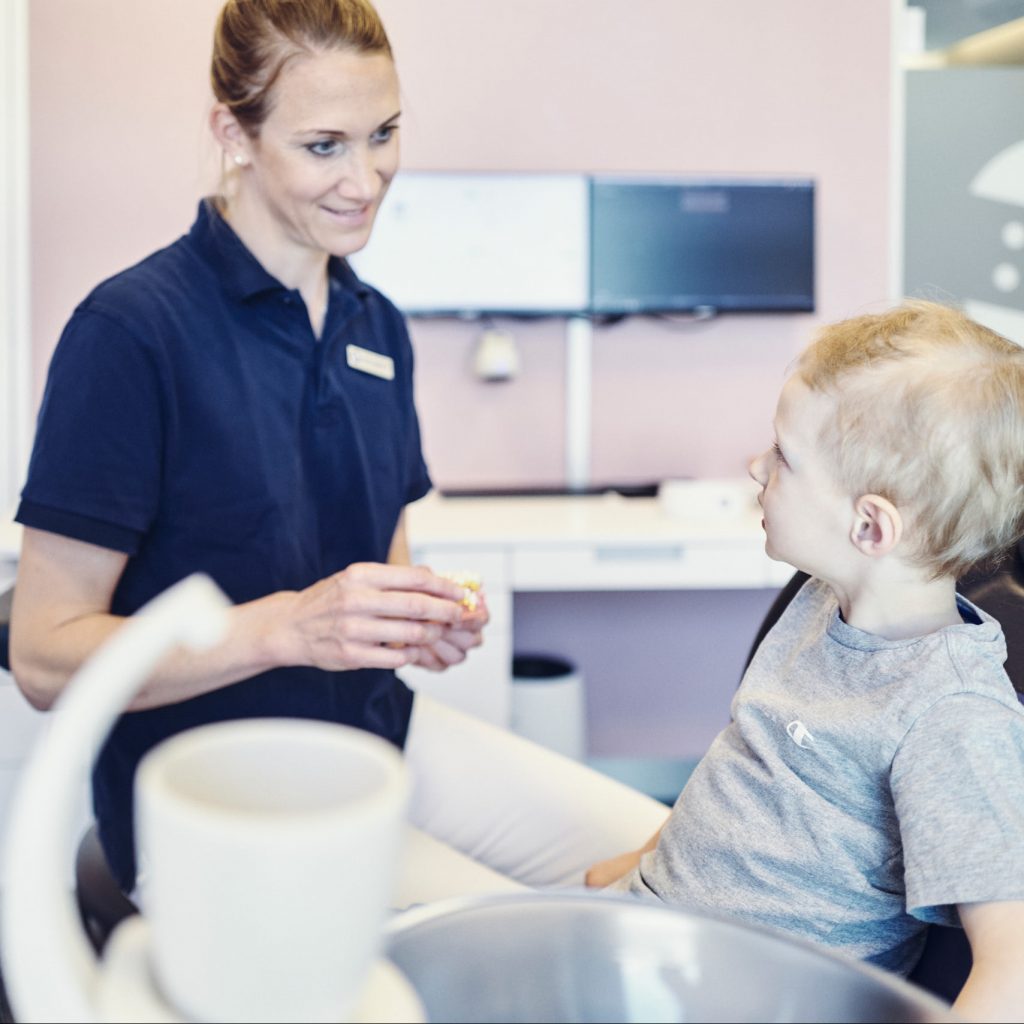
Our experienced team, led by M Dent Med Andrea Zimmermann with many years of experience in pediatric dentistry, makes sure that young patients feel at ease in a child-friendly environment. Playfully and with a great deal of empathy, we introduce the youngest to good oral hygiene.
With modern equipment and treatment methods tailored specifically to children, we take away fears and lay the foundation for a positive experience at the dentist.
Whether prevention, fissure sealing or more complex treatments – we accompany your children with patience, expertise and heart. Put your trust in Züri Zahni – we are professionals!

Why choose the pediatric dentist at Züri Zahni in Glattpark, Zurich?

Trust
The first contact with the children's dentist is groundbreaking for the future. We know exactly what it takes for children to feel completely comfortable with us and not to develop a fear of the dentist.

Experience
Thanks to our many years of experience in pediatric dentistry, we are able to master even complex cases – always with the child's well-being in focus and with the latest technology for support.

Diversion
With us, your children get headphones and can watch their favorite TV series on the screen, that helps incredibly – you'll see! After the treatment, the brave receive a small gift.
Interview with Andrea Zimmermann
We offer you the full range of pediatric dentistry
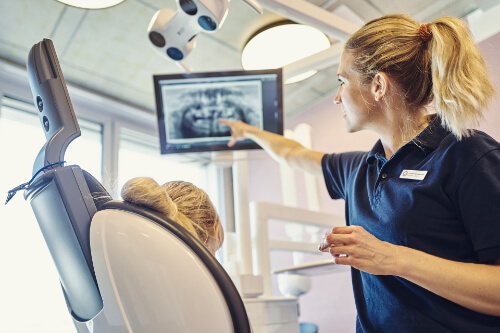
Initial examinations
In order for us to be able to build a solid and long-term relationship between the child and the practitioner, the first meeting is set to get to know each other and to do all the necessary examinations.
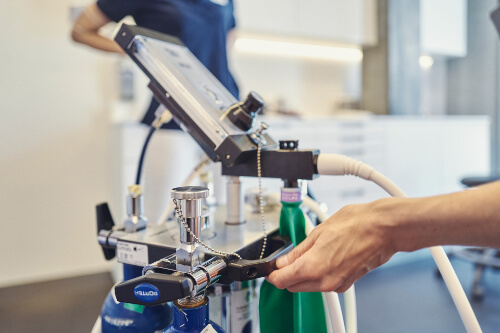
Nitrous oxide treatment
Should things become a little more difficult, we are professionals at carrying out nitrous oxide treatments. They allow anxious children to be treated very well and safely. Find out more.
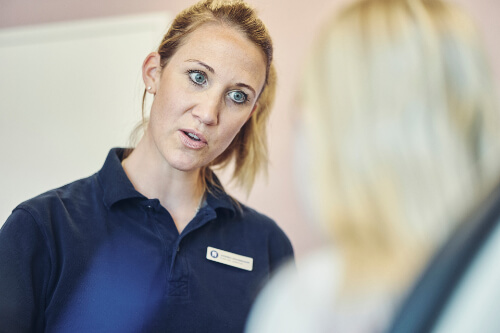
General anaesthesia
In the case of complex cases or major interventions, we can also carry out general anesthesia directly on site. That requires routine, experience and a well-established team.
Two-step treatment
We recommend starting early with a check-up at the pediatric dentist. Why? So that, for example, decays or problems with misaligned teeth can be recognized early and possible solutions can be worked out. We work extremely transparently and you will always receive a cost estimate, which we will discuss together so that you know exactly what to expect.
Request Appointment Now1. Contact us
Simply fill out an online form, send us an email or call us on the phone.
2. Initial meeting / preparation of documents
At the first meeting we build the important relationship between the child and the practitioner. This is how we lay the foundation for future anxiety-free dentist visits. We do a check-up, prepare the necessary documents, go through the treatment plan together and answer your questions. Now the treatment can be started.


WHAT OUR CUSTOMERS SAY ABOUT US

Meltem Ferro★★★★★ I had been looking for a good paediatric dentist for a long time because I wanted to avoid trauma from the dentist. Yesterday I was with my 3-year-old daughter at Mrs. Pejicic's and we were totally happy! They have an extra waiting room for children, the children can also choose a movie to watch in the room, the doctor explains all the steps and at the end you get a gift.

Calagan Özlem55★★★★★ The clinic is bright, welcoming, clean, furnished with the latest technology and very child- friendly! My 4-year-old son had to let go of his tooth. The preparation was very carefully planned and the extraction of the tooth was quick. In addition, the next day they sent SMS asking whether everything was okay.

Marco Cernuto★★★★★ I recommend this dental practice to everyone. The whole team is very friendly and likeable. Also very suitable for children as there is a play waiting room and children are allowed to watch cartoons on the ceiling while being treated. Thank you again and certainly see you next time.

Jessica Menzel★★★★★ My children have been checked by Mrs. Zimmermann before and are always happy to see her. The clinic looks great, is modern and easily accessible. The team is friendly, attentive and courteous. I cannot recommend this clinic enough. I will definitely come back and recommend it to my friends.

Björn Hering★★★★★ Great team, lovable, competent staff, also specialized in working with children. My daughter still talks about the impressive visit and shows her tooth gem all the time. :) Clinic of great design, with the latest equipment. I went shopping at Migros on the ground floor! Easy with public transport!

Nadine T★★★★★ Very nice, modern practice with a very likeable team. My son with Dr. Cano after only 1 minute forgot that he was actually afraid of the dentist. Dr. Cano took a lot of time and explained everything very nicely. We will come back and highly recommend this practice!

Linda Hering★★★★★ Our four-year-old son had to have his tooth fixed and, with the best will in the world, we didn't expect him to be willing to lie down in the chair the next day. Andrea Zimmermann did a great job! Humorous, competent and precise. The whole family trusts her now and is extremely satisfied.

Monika Maksimovic★★★★★ We always feel very warmly welcomed by Ms. Zimmermann and her team. My son likes the dentist very much and took yesterday's visit as a positive experience despite the "Löchli flicke". Thank you very much & stay the way you are.

Ilire Dakaj★★★★★ Best dentist I've ever seen. Everything's perfect. My son was treated so lovingly that he was not afraid of the dentist. I have never seen the way anything like Mrs. Zimmermann treating the little patients at the dentist. You have my loyalty! ⭐️⭐️⭐️⭐️⭐️⭐️⭐️⭐️⭐️⭐️

Get advice from our experts
My name is Andrea Zimmermann, I am co-founder and co-owner of the dental practice Züri Zahni. I am responsible for the field of pediatric dentistry and, together with my team, I am well prepared for a large number of treatment options.
Treatment of children is our heart's concern! Over the past 10 years, we have performed countless treatments and mastered our craft. But it is just as important to take the little ones by the hand and give them a sense of security so that they feel comfortable at the pediatric dentist.
Contact us for a consultation, we will be happy to answer your questions and explain what Züri Zahni offers.
STILL HAVE QUESTIONS?
DO YOU WISH AN APPOINTMENT?
Questions & answers
When should I take my child for their first dental visit?
The first visit to the pediatric dentist is recommended at the age of two. That way, young patients can be introduced to pediatric dentistry together with their parents in a calm, child-friendly atmosphere. At this age the milk teeth have fully erupted in most children.
For questions about diet and daily oral hygiene at home, we are happy to advise you from the moment the first milk teeth come through.
How do I prepare my child for the first visit to the pediatric dentist?
- Keep the day of the visit to your pediatric dentist as relaxed and stress-free as possible. - Make sure your child is well rested. Do not promise your child a reward, as that would suggest there is something to be afraid of. - If you have had bad experiences at the dentist in the past, keep those negative feelings and impressions to yourself. Wherever possible, your child should come without preconceptions.
- Avoid reassuring phrases such as "it definitely won't hurt" or "you don't need to be afraid". They tend to achieve the opposite. - Explain to your child how the visit to the pediatric dentist will go.
Why should I take my child to a pediatric dentist?
A pediatric dentist takes a very different approach from a dentist for adults, above all on the psychological level. It is important that they take a great deal of time for the children, explain everything necessary in language suited to a child, and prepare them playfully for upcoming treatments.
Childhood is when the foundation is laid for a relationship with the treating pediatric dentist that is free of fear and stress. Once a child realizes there is nothing to be afraid of, they are happy to come back.
How often should I clean my child’s teeth?
Your pediatric dentist recommends regular brushing from the moment the first tooth comes through. Once a day in the first year of life, twice in the second and three times a day from the second year onwards. It is important that you help your child brush, because at this age motor skills are usually not yet sufficient for perfect oral hygiene.
It should also be noted that, alongside a suitable brush head size, an age-appropriate toothpaste with an adjusted fluoride concentration (500ppm) should be chosen. Small children cannot spit out properly yet and swallow most of the toothpaste. Your pediatric dentist will gladly show how your child should hold the toothbrush and perform the correct brushing movements.
Why is oral hygiene so essential for children?
Keeping the milk teeth until they are lost naturally is of the greatest importance for the smooth development of the permanent dentition. Losing milk teeth early can lead to serious loss of space in the permanent dentition, which can often only be resolved with orthodontic intervention.
Your pediatric dentist helps your child develop optimal oral hygiene and maintain it, spot possible carious changes early and, where necessary, treat them gently and in a way suited to children.
How does my pediatric dentist repair my child’s teeth?
Your pediatric dentist usually repairs your child's decayed milk teeth with a tooth-colored composite. Purely technically, treating a milk tooth differs little from treating a permanent tooth.
When are crowns necessary for primary teeth?
If a milk tooth is badly destroyed by decay but keeping it is very important, your pediatric dentist may decide to use silver-colored steel crowns. This gives the badly damaged milk tooth circumferential stability.
When the corresponding permanent tooth comes through, the milk tooth fitted with a steel crown falls out quite normally.
What happens when a pediatric dentist has to pull a tooth?
If a milk tooth is hopelessly destroyed by decay, if the bone beneath it is inflamed, or if the milk tooth is fractured along its long axis, often the only option left to your pediatric dentist is to extract it. The neighboring teeth can tip into the gap and the resulting loss of space often cannot be made up again.
For this reason your pediatric dentist often plans a space maintainer made by the dental technician before the tooth is extracted, which can prevent the surrounding teeth from drifting.
When does a pediatric dentist opt for «laughing gas»-sedation?
If treatment is needed for your very young child whose cooperation is uncertain, the pediatric dentist may decide to carry it out under nitrous oxide sedation.
What is nitrous oxide and how does it work?
Nitrous oxide, or dinitrogen monoxide, is a colorless medical gas with a slightly sweet smell. During dental treatment the child breathes the nitrous oxide/oxygen mixture in through a nasal mask, which requires unimpeded nasal breathing. Nitrous oxide relieves anxiety and has a calming, relaxing and pain-inhibiting effect. It also reduces nausea and the gag reflex, and a tingling in the legs and feet and a feeling of heaviness may be noticed.
A calm atmosphere is needed during the treatment, because hearing is heightened under nitrous oxide. Your child loses their sense of time during treatment under nitrous oxide, so that the appointment feels shorter and the treatment as a whole more pleasant. Memory of the treatment is often reduced afterwards.
What are the benefits of nitrous oxide? Why is it popular in pediatric dentistry?
Because consciousness is maintained throughout the treatment, the patient — unlike under general anesthesia — is always awake and responsive. Their vital reflexes are not suppressed by the nitrous oxide, meaning breathing, swallowing and the gag reflex work normally.
Nitrous oxide is neither consumed nor stored by the body. It is simply breathed out again with the exhaled air. As soon as the nitrous oxide is stopped and pure oxygen is given for a few minutes, the child returns to their normal state. With responsible handling and correct use, incidents and complications are practically ruled out.
What are disadvantages of nitrous oxide?
Nitrous oxide sedation is regarded as a safe method of sedation. As a side effect, however, nausea or vomiting can occur on rare occasions. If there is a hypersensitivity, or if an unwanted reaction to nitrous oxide has occurred in the past, this must always be reported to your pediatric dentist.
When is outpatient general anesthesia necessary for a procedure?
In children and adolescents for whom treatment while awake is not possible – because they are very young, because of anxiety, or because of a medical condition.
For these patients we offer treatment under outpatient general anesthesia here at the practice. We are supported by an experienced external anesthesia team consisting of an anesthesiologist and a nurse.